

Before leaving his remote mountain village in Parbat District, Dhan Bahadur Gurung had a simple but powerful dream—to ensure that his family would never have to worry about food again. He imagined a life where they could sit together every morning and evening and eat without uncertainty. To make that dream a reality, he migrated to Saudi Arabia, where he worked as a waiter for nearly fifteen hours a day. Despite such exhausting labor, he earned only about 35,000 Nepali rupees per month.
Gurung, who had studied up to grade nine, had expected hard work abroad. However, he was surprised to find that even the long and demanding shifts in Saudi Arabia felt easier than the physically grueling labor he had endured back home. What he had not anticipated was the complete lack of rest—over a span of 16 years, he rarely had a single day off.
His life took a sudden turn when he developed a severe and persistent headache. At first, he dismissed it as minor and bought paracetamol from a pharmacy. But the pain did not subside. Within a week, his legs began to swell, alarming him. He went to a hospital, where doctors conducted blood tests and rushed him to emergency care. The diagnosis was devastating: his kidneys had failed.
“At that point, I didn’t even understand what kidney failure meant,” says Gurung, now 47. “I had no idea I had returned home with an incurable disease.”
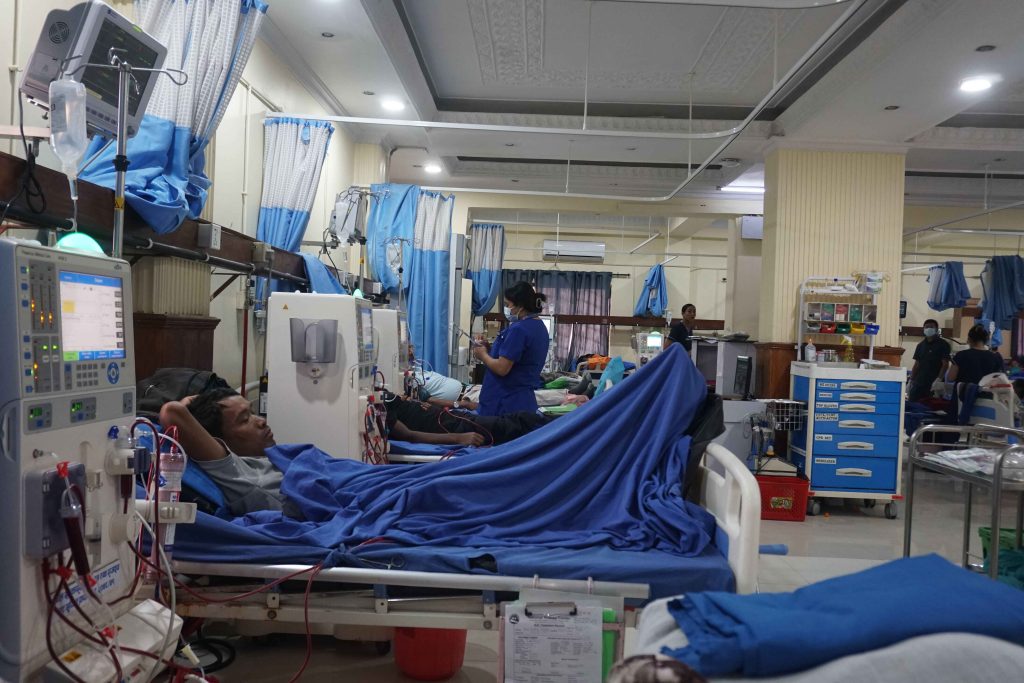
Today, he undergoes dialysis three times a week, each session lasting four hours—a routine that now defines his life.
Migration, Remittances, and Hidden Costs
Around 1.7 million Nepalis are currently working abroad, most of them in Gulf countries. Their remittances contribute more than a quarter of Nepal’s GDP, making foreign employment a cornerstone of the national economy. However, this economic success hides a growing human cost.
According to associate professor Dipesh Ghimire of Tribhuvan University, while remittances have helped reduce poverty, it is the young migrant workers who are paying the real price—often returning home with severe health problems, particularly kidney failure.
Causes: Heat, Dehydration, and Lifestyle
During his time abroad, Gurung consumed four to five energy drinks daily, believing they helped him stay energized and endure extreme heat. Senior nephrologist Dr. Rishi Kumar Kafle explains that such habits are increasingly common and dangerous.
“Kidney failure among migrant workers is often linked to dehydration, excessive energy drink consumption, high meat intake, and lack of rest,” he says.
Many workers come from cool, mountainous regions and struggle to adapt to Gulf temperatures that frequently exceed 40°C. Long working hours in intense heat, followed by sudden exposure to air-conditioned environments, disrupt the body’s fluid and electrolyte balance, placing significant strain on the kidneys.
A study conducted jointly by researchers in Nepal and the UK, involving 1,438 participants in Dhanusha District, found that although severe kidney dysfunction is not widespread overall, returnee migrant workers face significantly higher risks.
Prolonged dehydration reduces blood flow to the kidneys, which can lead to acute kidney injury. When this happens repeatedly, it may progress to chronic kidney disease and eventually complete kidney failure.
Climate Pressure and Labour Demand
The crisis is further intensified by climate change. Gulf countries are warming nearly twice as fast as the global average. In 2024, temperatures in cities like Riyadh reached around 46°C, creating extremely hazardous working conditions.
Despite these risks, the Gulf remains the primary destination for Nepali migrant workers—a trend rooted in the liberalization of Nepal’s labor policies in the 1990s and the rapid construction boom in the Middle East.
Another Story: Lal Singh Gharti
Lal Singh Gharti from Rolpa followed the same path as many others, going abroad to secure a better future for his children. For three years, he worked in Saudi Arabia and Dubai, carrying heavy loads and laboring on construction sites while sending money home.
At just 32 years old, he collapsed at work. Doctors later confirmed that his kidneys had failed. With no savings left, he returned to Nepal and has been dependent on dialysis for the past eight years.
Now 40, he says, “I can’t do anything anymore. Dialysis has weakened my body.”
His wife earns about 15,000 rupees per month as a school cleaner—barely enough to cover treatment costs, household expenses, and their children’s education.
Financial Burden Despite Free Treatment
Since 2016, Nepal has provided free dialysis and transplant services, along with a monthly allowance of Rs. 5,000 for kidney patients. However, for individuals like Gurung, this support is far from sufficient.
Living in Kathmandu to stay close to treatment facilities, he spends over Rs. 50,000 per month on medicines, injections, and essential care. “The support barely covers a fraction of my actual expenses,” he says.
Between July 2025 and July 2026 alone, 28 returnee migrant workers were diagnosed with kidney failure at a major treatment center.
A Cycle of Poverty
Experts warn that kidney failure traps families in a devastating cycle. As Dipesh Ghimire explains, when the primary breadwinner becomes chronically ill, entire households quickly fall below the poverty line.
The situation is worsened by the nature of kidney disease—it often shows no symptoms until 70–80% of kidney function is already lost, making early detection extremely difficult.
Prevention and Policy Gaps
Dr. Kafle emphasizes prevention as the most effective solution: drinking adequate water instead of energy drinks, getting regular health checkups, avoiding unnecessary medications, and taking rest during work.
Labour migration expert Rameshwar Nepal criticizes the government for failing to protect its workers. He argues that while the country benefits from remittances, it does not provide adequate support when workers return sick.
“The government is effectively trapping its citizens in a cycle of debt and illness,” he says.
Meanwhile, a spokesperson from the Ministry of Labour, Employment and Social Security acknowledges efforts to improve worker safety but admits limitations.
“We cannot simply stop sending workers abroad,” he says. “If Nepal withdraws, other countries will fill the gap.”
A Life Between Survival and Despair
For many patients, hope remains distant. Gharti has been unable to find a kidney donor and expects to rely on dialysis for the rest of his life.
In a quiet, despairing voice, he says, “I am waiting for death. I know I cannot recover… but I cannot die either.”
सम्बन्धित खवर