


KATHMANDU, JUNE 3
Proceedings of both chambers of the Federal Parliament—the House of Representatives and the National Assembly—were brought to a standstill on Monday after opposition parties intensified their protests against Prime Minister Balendra (Balen) Shah’s controversial remarks regarding Nepal-India border issues. The continued obstruction prevented lawmakers from carrying out any of the scheduled legislative business in either House.
The meeting of the House of Representatives, originally scheduled earlier in the day, eventually began nearly three hours late. However, shortly after the session commenced, opposition lawmakers disrupted proceedings, arguing that matters concerning national sovereignty and territorial integrity could not be treated lightly or subjected to political compromise. They insisted that Prime Minister Shah either withdraw his statement or present credible evidence to substantiate his claim.
The controversy stems from comments made by the prime minister during Sunday’s parliamentary session, when he stated that he had been surprised to discover that Nepal, in addition to India, had also encroached upon Indian territory. The remark immediately triggered strong reactions from opposition parties, which demanded that the statement be removed from the official parliamentary record unless supporting facts and documentation were provided.
As tensions escalated inside the chamber, Speaker Dol Prasad Aryal repeatedly appealed to protesting lawmakers to return to their seats and allow parliamentary business to continue. He stressed the importance of proceeding with crucial agenda items, particularly discussions related to the national budget and other legislative matters. Despite multiple attempts to restore order, opposition members remained firm in their protest, making it impossible for the House to function normally.
Unable to proceed with the day’s agenda, Speaker Aryal adjourned the meeting and announced that the next sitting of the House of Representatives would take place on June 8 at 11:00 a.m. Before ending the session, he was only able to read a communication from the Office of the President concerning the authentication of a bill.
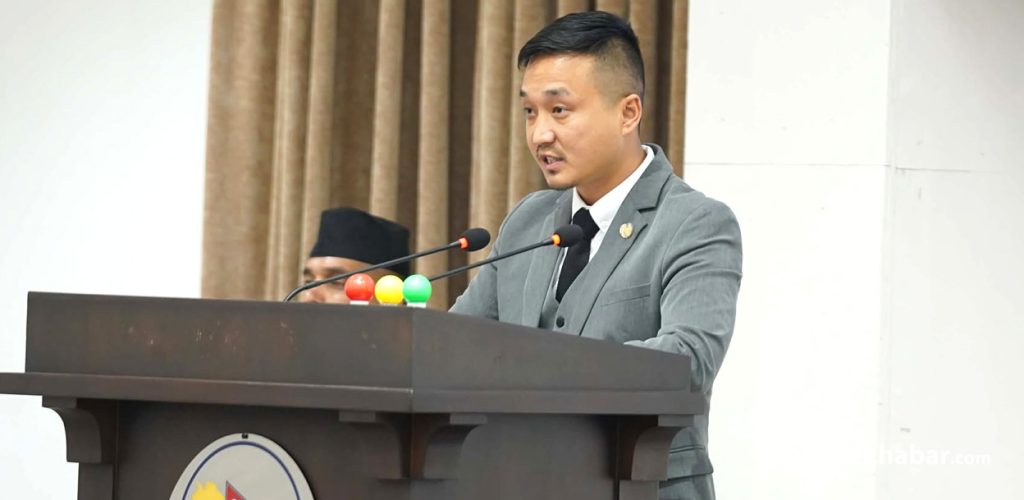
During the brief period in which lawmakers were allowed to express their concerns, Nepali Congress parliamentarian Abhishek Prasad Sah urged the prime minister to clarify his position regarding the Nepal-India border dispute. He reminded the House that his party had already submitted a formal objection over the statement and expected a clear explanation from the government.
Similarly, Harka Raj Rai, president of the Shram Sanskriti Party and a member of parliament, stressed that safeguarding Nepal’s territorial integrity is a collective responsibility shared by all elected representatives. He argued that issues involving national borders require utmost seriousness and factual accuracy.
Rastriya Prajatantra Party lawmaker Khushbu Oli also criticized the prime minister’s remarks, stating that the head of government speaks not merely as an individual but as the representative of a national institution. According to her, such statements could create confusion both domestically and internationally and therefore should be made only after careful consideration.
Yubaraj Dulal of the Nepali Communist Party echoed similar concerns. He emphasized that national leaders must rely on verified facts when discussing sensitive issues such as territorial disputes. Dulal further called upon the ruling coalition to publicly clarify its official position on the matter, adding that Parliament should be allowed to function normally once that clarification is provided.
CPN-UML parliamentarian Ganesh Singh Thagunna argued that there is a significant difference between unresolved border disputes and active territorial encroachment. He maintained that Nepal’s geographical sovereignty is non-negotiable and should never become the subject of careless political remarks.
The controversy was not limited to the lower house. The National Assembly also witnessed disruptions as opposition members protested the prime minister’s statement. As soon as the Upper House session began, lawmakers obstructed proceedings and refused to allow scheduled business to move forward.
National Assembly Chairperson Narayan Prasad Dahal repeatedly urged members to consider the importance of the legislative agenda and allow the House to continue its work. However, opposition lawmakers remained unmoved, insisting that discussions on parliamentary business could not proceed until the government addressed concerns regarding the prime minister’s comments.
As a result, Chairperson Dahal adjourned the meeting until 12:15 p.m. the following day without completing any of the scheduled agenda items.
The Upper House had been expected to receive and read a presidential communication regarding bill authentication. It was also scheduled to welcome Finance Minister Swarnim Waglé, who was set to present the government’s annual revenue and expenditure estimates for the fiscal year 2026–27 for general discussion. In addition, he was expected to introduce the Alternative Development Finance Mobilisation Bill, 2026, which had already been transmitted from the House of Representatives.
Before the adjournment, National Assembly member Padam Bahadur Pariyar demanded that the prime minister personally appear before Parliament with detailed maps, documents, and data identifying the specific areas he claimed Nepal had encroached upon. Pariyar argued that such a serious allegation must be supported by verifiable evidence.
Lawmaker Roshani Meche maintained that Nepal has never occupied another country’s territory and expressed concern over the implications of the prime minister’s statement. Likewise, Tul Prasad Bishwokarma emphasized the need to distinguish between the use of land by local communities and formal border encroachment between sovereign nations.
Meanwhile, National Assembly member Mahanta Thakur offered a different perspective. He argued that even if some Nepali citizens happen to use land that legally falls within Indian territory, such circumstances should not automatically be interpreted as deliberate or organized encroachment by the Nepali state.
Thakur further reminded lawmakers that Indian security forces have long maintained a presence in areas such as Limpiyadhura and Lipulek, territories that Nepal officially claims as part of its sovereign land. In his view, concerns about territorial encroachment should therefore focus primarily on these longstanding disputes.
He also expressed concern that the prime minister’s choice of words could complicate ongoing diplomatic efforts between Nepal and India aimed at resolving border disagreements through dialogue and mutual understanding.
With opposition parties refusing to back down and the government yet to provide a detailed clarification, uncertainty continues to surround the functioning of Parliament. The dispute has not only stalled legislative business but has also intensified political debate over national sovereignty, border management, and the responsibilities of public officials when addressing sensitive national issues.
सम्बन्धित खवर